
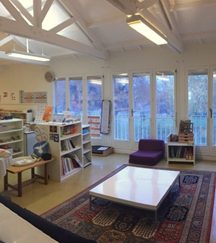
The school's philosophy
Our staff remain true to and develop even further the following beliefs of Dr. Maria Montessori :
- to respect the sensitive periods of development
- to respect the child as an individual
- to encourage the child's natural pattern of development
- to view education as the development of the whole child as well as his intellectual development
- to develop interests in his surrounding world rather than the simple transmission of facts
- to use a method of scientific observation to determine the learning environment that best meets the nature and needs of the child
The basic idea in the Montessori philosophy of education is that every child carries unseen within him the man he will become. In order to develop his physical, intellectual and spiritual powers to the fullest, he must have freedom - a freedom to be achieved through order and self-discipline.
The world of the child is full of sights and sounds which at first appear chaotic. From this chaos, the child must gradually create order, and learn to distinguish among the impressions that assail his senses, slowly but surely gaining mastery of himself and his environment.
Dr. Maria Montessori developed what she called the 'prepared environment' which already possesses a certain order and disposes the child to develop at his own pace, according to his own capacities, and in a non-competitive atmosphere in his first school years.
« Never let a child risk failure, until he has a reasonable chance of success »
said Dr. Montessori, understanding the necessity for the acquisition of a basic skill before its use in a competitive learning situation. The years between three and six are the years that a child most easily learns the ground rules of human behavior. These years can be constructively devoted to 'civilising' the child - freeing him through the acquisition of good manners and habits, to take his place in his culture. The child who has had the benefit of a Montessori environment is freer at a later age to devote himself more exclusively to the development of his intellectual faculties. The method by which children are taught in the Montessori school might well be called 'programmed learning'. The structure of Montessori learning involves the use of many materials with which the child may work individually. At every step of his learning, the teaching material is designed to test his understanding and to correct his errors.
Maria Montessori
Maria Montessori was born in 1870. She becomes at the age of 26, one of the first women doctors of medicine, of Italy. She is given the responsibility of the school of Speech Therapy of Rome. She represents her country in various Feminist congresses and speaks out against child labor.
She studies and translates the works of the two renowned French doctors, Itard and Seguin. The first Casa dei Bambini (Children’s House) is inaugerated in a popular neighborhood of San Lorenzo, Rome, on January 6, 1907.
Over the following year, several Children’s Houses are opened in Italy and Maria Montessori begins training teachers in her new method of education. In 1917, the year of the Universal Expo, Maria Montessori is invited to the United States to participate in Congresses there.
To escape fascism, she leaves Italy and goes to Spain in 1934. The Spanish Civil War breaks out and she is welcomed in England and then moves onto Holland. In the beginning of the Second World War she leaves Holland for India where she stays for the duration of the war. She continues to train teachers there and meets Gandhi.
In 1949, she receives the Legion of Honor at the Sorbonne in Paris. She is nominated for the Nobel Peace Prize in 1949, 1950 and 1951. She dies on May 6, 1952 and is burried in Holland.
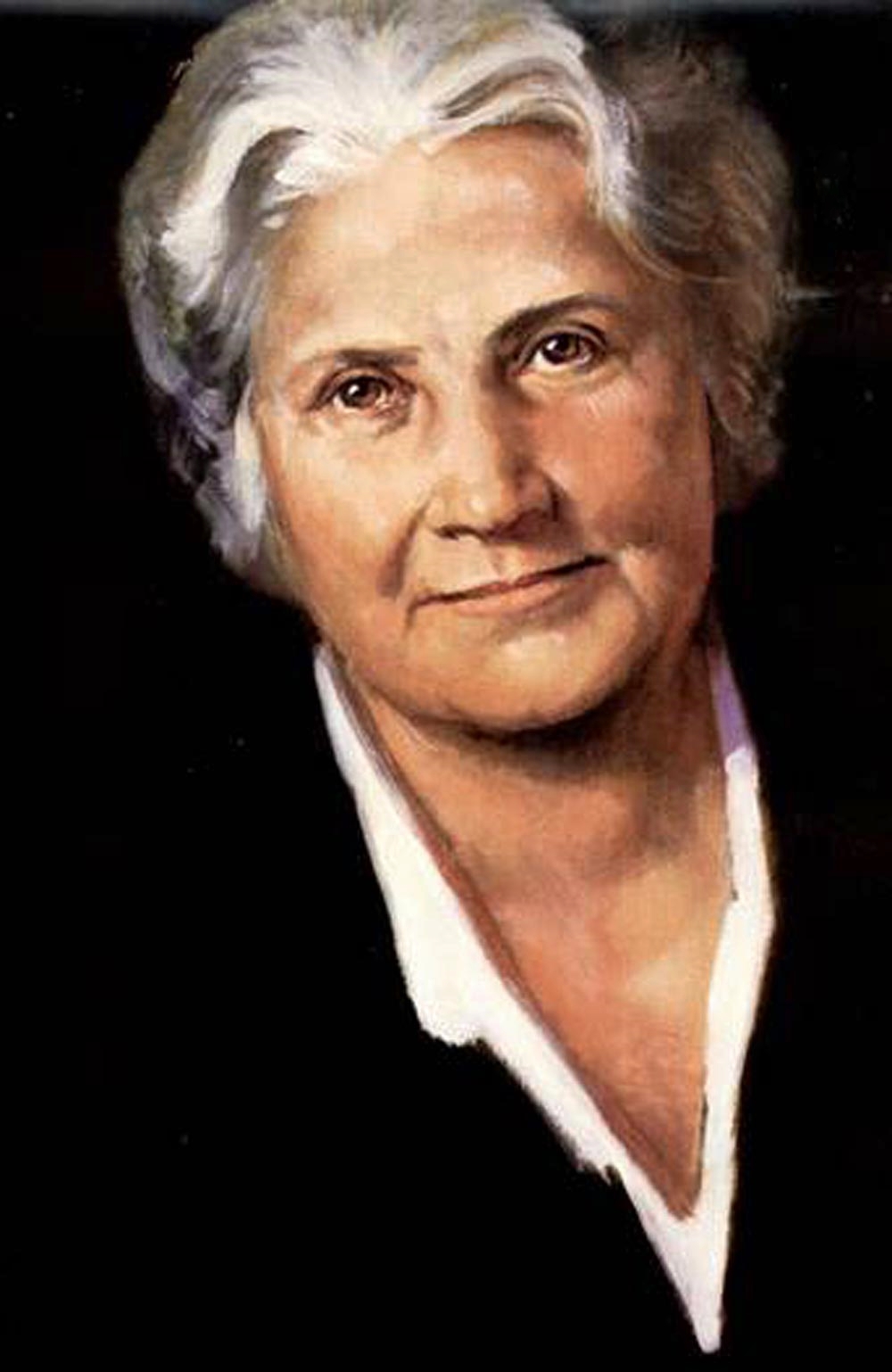
«Education is a natural process carried out by the human individual, and is acquired not by listening to words, but by experiences in the environment..» Dr. Maria Montessori «Education starts at birth.»
Dr. Montessori had recognized that children have a natural impulse to move themselves toward learning. The teacher prepares the environment, programs the activities, functions as the reference person and exemplar, offers the child stimulation, but it is the child who learns, who is motivated through the work itself (not solely by the teacher's personality) to persist in his chosen task. If the Montessori child is free to learn, it is because he has acquired from his exposure to both physical and mental order, an 'inner discipline'. This is the core of Dr. Montessori's educational philosophy. Social adjustment, though it is a necessary condition of learning in a schoolroom, is not the purpose of education. Patterns of concentration, ability to persevere, and thoroughness established in early childhood, produce a confident and competent learner in later years. Schools have existed historically to teach children to observe, to think, to judge. Montessori introduces children to the joy of learning at an early age and provides a framework in which intellectual and social discipline go hand in hand.
Montessori was one of the first to tempt to put into place a true science of education. Her approach consisted in installing the 'science of observation'.
Bibliography
Some of Maria Montessori's major works for parents and professionals:
- Dr. Montessori's Own Handbook (1914)
- The Child in the Family (1929)
- The Secret of Childhood (1936)
- Education for a New World (1947)
- To Educate the Human Potential (1947)
- The Discovery of the Child (1948)
- From Childhood to Adolescence(1948)
- Peace and Education (1949)
- The Formation of Man(1949)
- The Absorbent Mind (1949)
Books about Montessori :
- Maria Montessori: Her Life And Work by E.M. Standing
- Montessori: The Science Behind The Genius by Angeline Stoll Lillard
- Maria Montessori by Rita Kramer
- Understanding The Human Being by Silvana Montanaro
- How To Raise An Amazing Child by Tim Seldin
- Montessori Madness by Trevor Eissler
- Montessori From The Start: The Child At Home From Birth To Age Three by Paula Polk Lillard
- A Parent's Guide To The Montessori Classroom by Aline D. Wolf
- Our Peaceful Classroom by Aline D. Wolf
- The World Of The Child by Aline D. Wolf
- Montessori Insights: For Parents Of Young Children by Aline D. Wolf
- Nurturing The Spirit by Aline D. Wolf
Les livres au sujet de la philosophie et pédagogie Montessori :
- L'Ambiance Montessori, un guide pour les parents par Aline D. Wolf chez Le livre d'art
- Montessori de la Naissance à 3 ans par Charlotte Poussin chez Eyrolles
- Apprends-moi à faire seul par Charlotte Poussin chez Eyrolles
- Une journée Montessori: Organisez votre quotidien pour révéler les super pouvoirs de votre enfant ! de Audrey Zucchi Broché
- Quinze Pédagogues : leur influences aujourd'hui de J. Houssaye Chez Armand Colin
- Guide des Premiers Pas de M. Lorans Chez Ouest France
- Place à l'Enfant de J. Toulemonde Chez Encre
- Un autre regard sur l'enfant de Patricia Spinelli et Karen Benchetrit chez DDB


